Hopes are high for the India-US trade deal ahead of the August 1 deadline for new tariffs. However, the much-awaited trade deal could face a setback due to milk from cows. To be precise, non-vegetarian milk is currently the heart of the problem.
Donald Trump Looking Forward For A Deal With India?
The US president has signaled that a new trade deal could be inked soon with a country, and it could possibly be India.
"We have another deal coming up, maybe with India," Trump said as per Reuters report. His statement comes at a time when both countries' commerce ministry officials are prepping for another round of trade talks.
What Is Non-Veg Milk And Why Is It Drawing A Red Line Between India-US Trade Deal?
Amidst many items that are being discussed in the trade talks, as per reports, US and India seem to be struggling to find common ground related to non-veg milk.
Yes, you have read it right! Reportedly, India and US are not able to make a decision on milk, as they both look to the dairy sector, which feeds over 1.4 billion people and has over 80 million jobs.
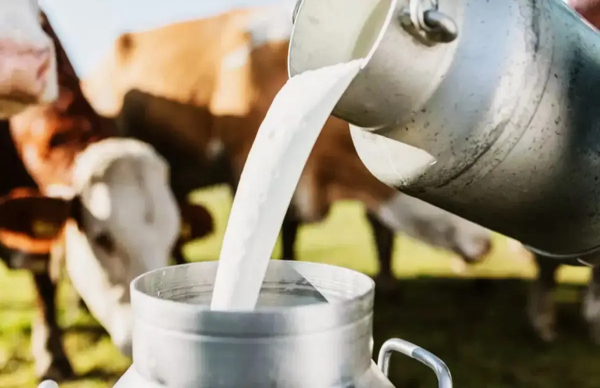
In general terms, milk is considered a 100% vegetarian item, because it is mainly a secretion of an animal (cow, buffalo or goat, etc.) and not part of its flesh. Also, milk does not carry any bio cells, unlike an egg. By logic, milk is considered vegetarian. At least that is the case in India.
However, in the USA, there is non-veg milk as well. Milk becomes non-vegetarian when they are squeezed out of an animal that was fed on meat, bones or blood, among other flesh-related substances.
According to a 2004 report by Seattle Post-Intelligencer, "Cows are still allowed to eat feed that can include parts of pigs, fish, chicken, horses, even cats or dogs... And cattle can continue to consume pig and horse blood for protein, as well as tallow, a hard fat from rendered cattle parts, as a fattening source."
This is a problem for India, which consumes milk not just for health, but also considers it sacred for religious practices. Cows in India are given a strict vegetarian diet, unlike in the USA.
That is why India finds the trade talk related to non-veg milk as a "non-negotiable red line". India has urged that there should be strict certification on imported milk, revealing the origin that they have come from cows who weren't fed animal-based products.
Ajay Srivastava of Global Trade Research Institute (GTRI), a New Delhi-based think tank, told PTI, "Imagine eating butter made from the milk of a cow that was fed meat and blood from another cow. India may never allow that."
Meanwhile, US calls India's demands an "unnecessary trade barrier". A report of the Times of India highlighted that the US took the matter to the World Trade Organisation (WTO), and signalled that India's updated dairy certification, effective from November 2024, does not state such concerns.
The deal with imported milk from the USA could have a negative impact on India. Another report of ANI cited an analysis of SBI, which stated that India could suffer a Rs 1.03 lakh crore annual loss if it allows US dairy products.
Earlier, as per the International Dairy Foods Association (IDFA) report, the U.S. dairy industry is poised to establish a new "golden age" of U.S. dairy trade, with exports reaching $8.2 billion in 2024-the second-highest total export value ever and a $223 million year-over-year increase.
IDFA added that the U.S. dairy industry, which supports more than 3.2 million jobs in the United States and pumps almost $800 billion into the U.S. economy, has invested more than $8 billion in new processing capacity that will come online in the next few years. After being a net importer of dairy products a decade ago, the United States now exports $8 billion worth of dairy products to 145 countries. U.S. dairy exports have nearly tripled since the early 2000s.
Meanwhile, as per the Ministry of Commerce and Industry data, India now has indisputably the world's biggest dairy industry in terms of milk production; during 2022-23, India produced close to 230.58 million tonnes of milk. The dairy sector in India has shown remarkable development in the past decade, and India has now become one of the largest producers of milk and value-added milk products in the world.
For investment related articles, business news and mutual fund advise



 Click it and Unblock the Notifications





 Sign in with Google