The U.S. dollar index, down more than 11 percent, has experienced its worst first seven months of the year since 1973, primarily due to sell-offs by global investors in response to President Trump's policies and tariffs. However, this has given a boost to emerging market currencies, including the Indian rupee, and the stock market in the past month.
President Trump's tit-for-tat tariffs and worry over the U.S. Federal Reserve's future may further depreciate the greenback as its "safe haven" status is threatened, according to foreign exchange strategists around the world.
The dollar index, which measures the U.S.currency against six others, has fallen over 11 percent this year so far and about 2 percent in the past month. That has boosted most emerging market currencies, including the Mexican peso, Chinese yuan, and the Brazilian peso, which appreciated, while the Indian rupee has remained volatile.
(Past 1 Month Performance)
"Currencies have been driven more by geopolitical events rather than fundamentals such as relative interest rates and growth differentials recently. The key upcoming event risks include the expiration of the 90-day reciprocal tariff pause in July. Markets appear to have priced out the risk of higher US tariffs for now. Also front and centre will be US tax reform and the impact on its fiscal deficit, and developments in the Middle East," noted David McNamara, chief economist at AIB.
"Against this uncertain backdrop, the dollar is likely to remain on the defensive and will be prone to volatility, with obvious risks to the downside. The policy trajectory of the Fed could be a key driver here, with markets now pricing in a Fed funds rate at 2.9% by end-2026, compared to an FOMC median projection of 3.6%."
Despite the strong US job report, the dollar continues to lose momentum, staying below 97 as concerns over trade policy overpower bearish sentiments.
What Is The Rupee Path Now?
The rupee has shown a mixed performance so far this year. It has depreciated around 2.5 percent against the U.S. dollar but in the past month has shown some resilience. As of July 4, 2025, it is trading in the range of 85.31 to 85.50 against the US dollar.
Key Factors Influencing the Rupee's Performance this year
US Dollar Recovery (If Any): The U.S. dollar can put pressure on the Indian rupee if it recovers from the recent low. The greenback is still considered the safe-haven currency in the world of foreign exchange, and any positive move can put considerable pressure on the rupee.
Global Trade Tariff Concerns: Uncertainty surrounding new US tariff measures has contributed to market caution.
Rising Gold Imports and Weak Goods Exports: These factors contribute to a widening current account deficit, which typically weakens the rupee.
Foreign Portfolio Outflows: Despite some recent inflows, there have been periods of capital outflow as investors sought more stable or higher-return markets.
RBI's Strategic Shift: The Reserve Bank of India (RBI) has reportedly reduced its interventions, allowing the rupee to experience more market-driven volatility and depreciation at times.
Domestic Economic Factors: While India's macroeconomic fundamentals are generally strong, concerns about inflation and fiscal stability, as well as geopolitical tensions (like India-Pakistan in May), have periodically impacted sentiment.
"Indian rupee gained to 85.18 last backed by flows from FPIs and absence of RBI and oil companies from the dollar buying side should be in a range of 85.20 to 85.80 this morning as it opens near 85.50. Today, US dollar cash transactions will be absent, but we may seethe rupee move between the above range as traders hedge their respective positions," said Anil Kumar Bhansali, head of treasury at Finrex Treasury Advisors.
" The U.S.-India interim trade deal, though in its final stages, has still not been announced as Trump prepares to send letters to individual countries on what their tariff rates would be.Upticks to the dollar may be sold by exporters, while any downtick may be bought by the importers."
Nifty And Sensex Outlook Stable For 2025
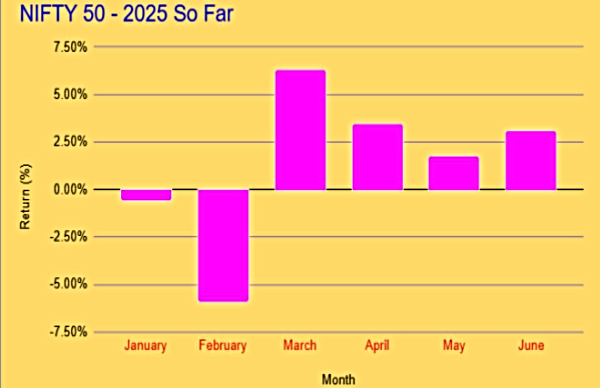
Nifty and Sensex have gained about 7 percent and 6 percent so far this year despite Trump's rollercoaster ride on tariffs, geopolitical tensions in the Middle East, and a volatile rupee.
Nifty 50 Performance
"A weaker USD, especially when tied to the expectation of rate cuts in the US, will generally have a positive impact on Foreign Institutional Investor behaviour, as Investors will rotate from developed markets into emerging markets to seek higher yields," said Ross Maxwell, Global Strategy Operations Lead, VT Markets.
"This can have a positive impact on Indian Equities, as it brings more capital inflows into the country, supporting the rupee and lowering bond yields. Lower prices for USD-denominated commodities such as metals and crude oil will reduce inflationary pressures and boost Indian companies, although some export sectors such as IT and Pharmaceuticals may face challenges. Overall returns on Indian assets can also increase, as the cost of hedging positions decreases with a weaker USD, which can boost Investor capital flows into bonds and equities."
For investment related articles, business news and mutual fund advise



 Click it and Unblock the Notifications







 Sign in with Google