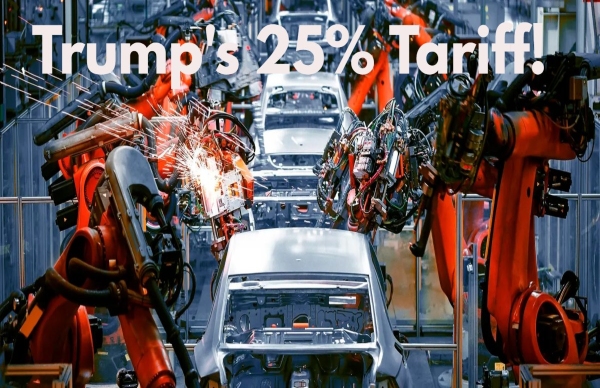
Donald Trump has yet again rocked the global market with his tariff plans, and this time it would be the automobile companies to bear the brunt. All foreign auto giants who sell cars in the US, but do not have manufacturing facilities, will face 25% tariffs. Wall Street crumbled, and so did the Asian and Indian markets.
Trump's 25% Tariff On Automobiles:
The White House on Wednesday announced a 25% tariff on imports of automobiles and certain automobile parts, addressing a critical threat to U.S. national security.
The move is to protect America's automobile industry, which is vital to national security and has been undermined by excessive imports threatening America's domestic industrial base and supply chains, the White House said.
A 25% Tariff will be imposed on imported passenger vehicles (sedans, SUVs, crossovers, minivans, cargo vans) and light trucks, as well as key automobile parts (engines, transmissions, powertrain parts, and electrical components), with processes to expand tariffs on additional parts if necessary.
However, Mexico and Canada would get some exceptions. The White House announced that importers of automobiles under the United States-Mexico-Canada Agreement will be allowed to certify their U.S. content and systems will be implemented such that the 25% tariff will only apply to the value of their non-U.S. content.
This development is expected to adjust imports being brought into the United States in quantities or under circumstances that threaten to impair national security.
Take a Poll
Data from the White House revealed that in 2024 alone, American citizens purchased about 16 million cars, SUVs, and light trucks, and 50% of these vehicles were imports (8 million). Of the other 8 million vehicles assembled in America and not imported, the average domestic content is conservatively estimated at only 50% and is likely closer to 40%. Hence, of the 16 million cars bought by Americans, only 25% of the vehicle content can be categorized as Made in America.
In 2024, The USA's trade deficit in the automobile sector reached $93.5 billion in 2024. There has been a sharp decline in automobile jobs as well. In 2024, the employment in automotive parts manufacturing totalled around 553,300 jobs, down by 286,000 jobs or 34% since 2000.
White House cited that studies have repeatedly shown that tariffs can be an effective tool for reducing or eliminating threats to impair U.S. national security and achieving economic and strategic objectives.
Josh Hawley, senior US senator, called out luxury cars and foreign carmakers such as BMW. He said, "You are more than welcome to open your auto plants in Missouri. You don't want to pay 25% tariffs? Come on over-our door is open!"
Hawley also said that Trump's tariffs would mean more automobile jobs in America and higher wages. He added, "Americans are tired of getting ripped off by Mexico and other foreign countries," We need a fair deal on trade, and Trump is going to get us one"
Who Wins, Who Losses?
According to a valuation expert, Buy Side Alpha, Elon Musk-backed Tesla is the biggest winner because a 25% tariff would give the US-based EV giant a major price edge compared to foreign electric cars like BMW i4 or Hyundai Ioniq 6.
The second winner is likely to be General Motors which has a massive US manufacturing footprint with a strong SUV/truck portfolio. The third winner is expected to be FORD who just like GM, has high-margin US-built trucks. The fourth winner is seen to be Stellantis despite having headquarters in Europe, this is because the company has large US production of its Jeep, RAM, and Dodge.
Companies like Dana Inc., BorgWarner, and American Axle are also seen as beneficiaries because they are US-based auto parts suppliers. In the used cars segment, US-based CarMax could benefit from new car price inflation.
Losers:
Among the losers are seen as Mercedes, Volvo, and BMW luxury automakers with huge US exposure but their production is mostly foreign. 25% tariff could squeeze their margins.
Importers like Toyota and Honda may also face the brunt despite US production. Hyundai a non-US company still heavily relies on imports for its Genesis G80, Hyundai Tucson, and Kia EV6 which could get more expensive due to the tariffs.
Also, US dealers who have imported brands such as Audi, Mazda, and Hyundai as their sales could be impacted.
Jonathan Smoke, chief economist at Cox Automotive told The New York Times that tariffs would add $6,000 to the price of a car made in Mexico or Canada, two of the top exporters of vehicles to the United States. Affected models include the Toyota Tacoma pickup, gasoline and electric versions of the Chevrolet Equinox, and several models of Ram pickups. Ram is owned by Stellantis, which also produces Dodge, Chrysler and Fiat vehicles.
Smoke told the US news agency that higher prices will deter buyers and force automakers to curtail production. He is expecting disruption to virtually all North American vehicle production by mid-April. He believes that US factories could produce 20,000 fewer cars per week, which would be 30% less than usual. The bottom line is that Trump's tariff could lead to lower production, tighter supply and higher prices in the auto sector.
For investment related articles, business news and mutual fund advise



 Click it and Unblock the Notifications





 Sign in with Google