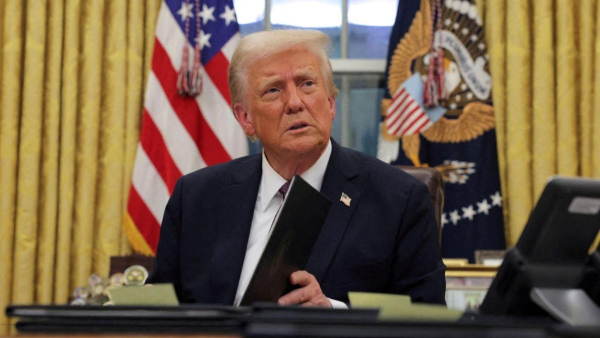
FIIs/ FPIs and DIIs Data: Foreign portfolio or foreign institutional investors have continued to be relentless sellers of the Indian stock market, with outflows of more than Rs 1 lakh crore so far in 2025. However, there is a new trend in the offing, while FIIs were back to the 'BUY China, SELL India' strategy, the US market emerged as the global hub for foreign investors to park their money. This can be attributed to US 47th President Donald Trump who has announced tariffs after tariffs on countries since he took over the White House office. Experts believe FIIs and FPIs will turn net buyers of Indian stocks on steady economic growth and revival in corporate earnings, which can be expected after the next 3 months, probably after Q4.
FIIs And DIIs Data:
As per Stock Edge data, FIIs have pulled out Rs 36,976.70 crore worth from Indian stocks in February 2025. In the previous month, the outflow was about Rs 87,374.66 crore. YTD, FIIs have sold Rs 1,24,351.36 crore worth of Indian stocks on BSE and NSE cumulatively.
Meanwhile, DIIs have become net buyers, with an inflow of Rs 42,601.02 crore in Indian stocks in February so far. In January 2025, DIIs bought Rs 86,591.80 crore worth of Indian equities. YTD, the inflow is about Rs 1,29,192.82 crore.
Notably, FIIs have been net sellers of Indian stocks since October 2024, while DIIs have been net buyers since May 2023. FII selloff commenced after Sensex and Nifty touched their all-time highs of 85,978.25 and 26,277.35 in late September 2024.
FPIs:
Data from NSDL showed that FPIs have sold Rs 23,710 crore worth of equities in February so far, while they sold up to Rs 78,027 crore in January month. YTD, FPIs sold about Rs 1,01,737 crore.
Trump Tariff Threats Impact:
According to Dr. V K Vijayakumar, Chief Investment Strategist, Geojit Financial Services, FII selling continues unabated in the Indian stock market. After selling stocks for Rs 81903 crores through the exchanges in January, FIIs followed it up by selling stocks for Rs 30588 crores in February through 21st. This takes the total selling in 2025, so far, to Rs 112492 crores (NSDL). This massive selling has resulted in the Nifty yielding negative returns of 4% YTD.
Vijayakumar further explained that after Trump's victory in US presidential elections, the US market has been attracting huge capital inflows from the rest of the world. But recently, China has emerged as a major destination of portfolio flows. The Chinese president's new initiatives with their leading businessmen have kindled hopes of a growth recovery in China.
He added, "The Chinese stock market responded positively to this. The Hang Seng index (FIIs buy Chinese stocks through the Hong Kong stock market) shot up by 18.7% in a month in sharp contrast to the 1.55 % decline in the Nifty. Since Chinese stocks continue to be cheap, this 'Sell India, Buy China' trade may continue. But this trade has happened in the past and experience is that it will fizzle out soon since there are structural problems constraining Chinese economic revival."
Vaibhav Porwal, Co-Founder, Dezerv also said, Since October 2024, India's market cap has fallen by about USD 1 trillion, while China's has risen by USD 2 trillion. This suggests a tactical shift in FII flows. Data from NSDL shows that Foreign Portfolio Investors (FPIs) pulled out approximately ₹25,000 crore from Indian equities in January 2024 alone, in sharp contrast to the substantial inflows of over ₹1.7 lakh crore in 2023. This FII outflow can be driven by several factors beyond simple reallocation"
Porwal highlighted the following:
India's growth and valuation concerns: Although India's long-term growth story remains strong, near-term valuation worries and concerns over sluggish corporate earnings have led to profit-booking. India continues to trade at a premium compared to other emerging markets, prompting global investors to reassess their positions. Also, a strong dollar often attracts capital to US markets, considered safer and more stable. This could have been a factor in FII outflow from emerging markets like India.
China's economic rebound: After a prolonged correction, Chinese equities have become attractively valued. Their economic stimulus package announced in September 2024, which includes policy support, regulatory easing, and measures to boost FII sentiment, has renewed investor confidence in China's recovery narrative.
Explaining in detail, Porwal said, China's recent rally can be attributed to a blend of factors, with its economic stimulus having an overarching impact on the economy. China has taken steps to stabilise its economy, including rate cuts, property sector support, and liquidity injections. These moves have helped restore investor confidence, particularly after prolonged policy tightening. The Chinese stocks have also been heavily discounted due to geopolitical tensions and regulatory uncertainties. Further, Deepseek has disrupted the US-led tech space by offering solutions at a fractional cost, making AI-driven solutions accessible to the rest of the world; however, it is too early to comment on the overall impact.
Meanwhile, Porwal said, India's premium valuation relative to peers like Indonesia, South Korea, and Taiwan has been a headwind. A consolidation or earnings-driven growth could reset valuations and make Indian equities more attractive.
When Will FIIs, FPIs Turn Buyers In Indian Stock Market?
In Vijayakumar's view, revival of FII investment in India will happen when economic growth and corporate earnings revive. Indications of that are likely to happen in two to three months.
Also, Porwal said, FII flows will be dependent on how the earnings growth recovers. That being said, FII flows could return to India in the next 3-6 months, as the economy and macro factors in the long term are favourable. Strong domestic demand, digital transformation, and infrastructure push are long-term drivers that are likely to bolster corporate earnings and sustain growth.
For investment related articles, business news and mutual fund advise



 Click it and Unblock the Notifications





 Sign in with Google