"If you aren't willing to own a stock for ten years, don't even think about owning it for ten minutes" is among many popular quotes from the Oracle of Omaha, Warren Buffett, when it comes to investing in the stock market. Rightly said, the power of long-term investing in stocks, an investment mechanism that is overly driven by sentiment, overpowers short-term fluctuations, reduces risks, and appreciates gains for investors. One great example is the BSE Sensex!
Sensex's Multi-Fold Performance:
On August 18, the BSE Sensex broke the pivotal 81,000 mark to end at 81,273.75. Overall, in the trading session, Sensex skyrocketed by a whopping 1,168.11 points to hit an intraday high of 81,765.77 before correcting as investors cashed in gains.
So far, 2025 has been volatile for the Sensex due to tariff trade tensions and global uncertainties. Still, YTD, Sensex has gained by 2,766.34 points, or 3.52%.
But did you know Sensex's all-time gains are breathtaking, at 14,387.04%, or 80,712.74 points? Once upon a time, Sensex stood at the 561.01 level on January 3, 1986.
This will be nearly 145 times returned in 4 decades. This is also better than global behemoths like US-based Dow Jones and Japan's Nikkei. From August 1985 to date, the DJIA has gained by 3,321.28%, and the Nikkei 225 has zoomed by 244.44%. Sensex outperformed the two leading global exchanges.
The highest level of Sensex is 85,478.25, which was recorded on September 27, 2024. Since then, the market has significantly corrected, as the overall Indian stock market was overvalued.
Over the period, Sensex has shown resilience against challenging conditions. For instance, Sensex went from 40,000 in 2020 to crossing 60,000 by September 2021 despite the shockwaves of the Covid-19 pandemic on the economy, businesses, and the common man in general.
That's not all, despite geopolitical tensions because of Russia-Ukraine and Israel-Hamas between 2022 and 2024, and still ongoing, Sensex crossed 85,000 for the first time in September last year.
Here are key milestones touched by Sensex over the past four decades:
(Image Source: Wikipedia, BSE)
Further, Sensex is expected to be unstoppable and even cross the barriers of 1 lakh, 1.5 lakh and 2 lakh in the next 10 years.
"Since the 1990s, we've had our share of shocks: the dot-com bubble, the subprime crisis, pandemics, and global slowdowns. Yet, the market has always found its way back up. Even now, we have challenges like the ongoing tariff wars, and such events will keep coming," said Navy Vijay Ramavat, MD, Indira Groups, to GoodReturns.
The expert further said, "We see the Indian economy doing well. Our growing role in global supply chains, political stability, a young workforce, and rising investor confidence are all positive signs. It is showing the kind of environment that suggests it can keep doing well for years to come. When the economy grows, the country's GDP grows. That growth eventually shows up in the market capitalisation of companies. And, the index is nothing different. That's the simple chain: a healthy economy fuels a growing Sensex."
Short-Term Shocks Expected, But Long-Term Growth To Be Worth The Wait!
In the short term, Ramavat believes markets did not perform well for almost 11 months since September, and this phase of consolidation could stretch another 5-6 months. That's normal, especially after the strong bull run of the past 4-5 years.
Over the long term, he added, "the picture remains positive."
Historically, the Sensex has delivered around 13% CAGR since 1990. Looking ahead, the expert believes Sensex could be compounding at roughly 10-12% CAGR.
When Will Sensex Hit 1,00,000, 1,50,000, and 2,00,000?
Ramavat told GoodReturns the following:
• At 10% growth, milestones could be 100,000 by FY28, 150,000 by FY31, and 200,000 by FY35.
• At 12% growth, these could arrive sooner-100,000 by FY27, 150,000 by FY30, and 200,000 by FY32-33.
To put things in perspective, he added, "In 1990, the Sensex was just 1,046. In 35 years, it has grown about 76 times, translating to a 13.2% CAGR. That's the power of staying invested through both calm and storm."
BSE-Listed Companies' Market Cap Bigger Than GDPs of Major Countries:
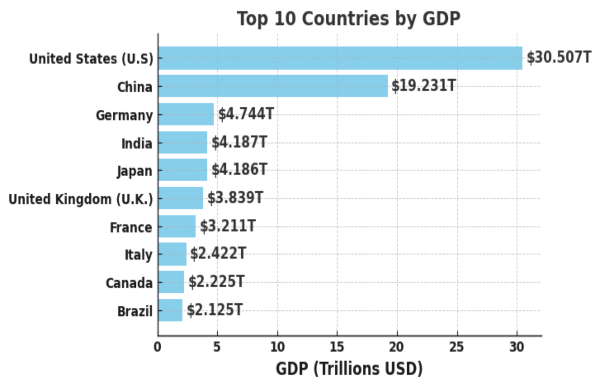
As of August 18, 2024, BSE-listed companies' market cap stood at Rs 4,50,96,486.46 crore, which is approximately $5.16 trillion. This makes BSE-listed companies' market capitalization bigger than Germany, Japan, the United Kingdom, France, Canada, Italy, Brazil, and guess what, India itself.
Top 10 GDPs, as per the IMF World Economic Outlook as of April 2025:
(Image Source: IMF)
At present, there are 4,365 stocks that trade on the BSE.
Recently, S&P Global Ratings upgraded India's sovereign rating to BBB for the first time since 2007, and this likely reinforces India as an attractive investment hub among global economies.
"S&P Global's upgrade of India's sovereign rating to BBB reflects the country's macroeconomic resilience and the steady execution of structural reforms. Over the last decade, India has combined fiscal discipline, monetary prudence, and targeted pro-growth policies to create an environment conducive to long-term investment. This upgrade reinforces India's standing as one of the most attractive destinations for global and domestic capital, underpinned by robust domestic demand, a rapidly digitalising economy, and deepening financial markets," said Gopal Jain, Managing Director and CEO, Gaja Alternative Asset Management, to GoodReturns.
"We expect this to accelerate investment activity across sectors such as financial services, consumer, technology, healthcare, and infrastructure. India's growing share of global savings, coupled with improved creditworthiness, will enable the country to attract more patient, long-term capital, supporting both economic growth and wealth creation in the years ahead," Jain added lastly.
Disclaimer: The recommendations made above are by market analysts and are not advised by either the author, nor Greynium Information Technologies. The author, nor the brokerage firm nor Greynium would be liable for any losses caused as a result of decisions based on this write-up. Goodreturns.in advises users to consult with certified experts before making any investment decision.



 Click it and Unblock the Notifications







 Sign in with Google