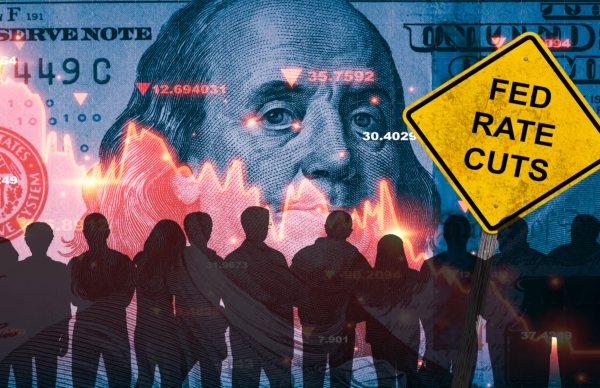
The US Federal Reserve has reduced key fund rates by 25 basis points for the first time in 9 months. New federal rates are in the range of 4% to 4.25%. This rate action was long overdue; however, from the latest Fed meeting, experts believe the FOMC is not clear whether the impact of US President Donald Trump's tariffs is a one-time or persistent case in the near future. US tariffs are yet to unfold their true colors on the economy, which is already seen on the brink of a potential recession.
US Fed FOMC Meeting Outcomes:
To support its goals and in light of the shift in the balance of risks, the FOMC decided to lower the target range for the federal funds rate by 1/4 percentage point to 4 to 4‑1/4 percent. FOMC is focused on achieving maximum employment and returning inflation to its 2% objective.
However, FOMC continues to view inflation as somewhat elevated, with uncertainty in the economy outlook remaining lofty. For the weakening labor market, the Fed judges that the downside risks to employment have risen.
Additionally, Fed's chair Jerome Powell has signaled for two more rate cuts in the October and December policy,
"The US FOMC's decision to deliver a 25bps rate cut was well telegraphed and in response to the weakening labour market. This move towards a more neutral policy stance garnered muted market reaction as the US Fed chairman characterised the rate cut as a risk management decision, " said Hitesh Suvarna, Research Analyst at JM Financial in a note.
Is Latest Rate Decision Meant To Divert A Potential US Recession?
The probability of a US recession is below 50%, but it has reached a 48% possibility, which was never this high.
Moody's economist Mark Zandi said, "There is an uncomfortably high 48% probability that the U.S. economy will suffer a recession in the next 12 months. That's according to Moody's recently unveiled leading economic indicator, derived using a machine learning algorithm on our extensive databases. It's less than 50%, but historically, the probability has never gotten this high, and a recession has not ensued."
The Fed is currently in a conundrum! It wants to curb the choppy labor market and, at the same time, not cut rates too deep when the inflation scenario is elevated due to the impending tariff impact.
Here are key points to know about the FOMC's latest meeting, as per JM Financial:
FOMC Unclear On Impact Of Tariffs:
The FOMC is not clear whether the impact of tariffs would be one-time or persistent, but Powell indicated that the pass-through has been gradual currently. Prima facie, this scenario will not warrant policy easing; however, with the shift in balance of risk towards further deterioration in the labor market. Powell characterized the current policy easing as "risk management" rather than a decision to support the economy.
Fed Prioritizes Weak Labor Market Over US Inflation:
The rapid deterioration in the labor market led to the change of policy stance to neutral. Powell indicated that both demand and supply of labor had moderated; stricter immigration policy led to the latter. While inflation remains elevated, the impact of tariffs is not meaningful due to a gradual pass-through. Overall, he highlighted that long-term inflation expectations are well anchored.
The US unemployment rate touched its record low at 4.3% in August 2025. However, the long-term unemployment data-which is people not working for 27 weeks or more-rose to 1.9 million in August, accounting for 25.7% of the total unemployment-which is also the highest since February 2022. This reportedly signals a deeper problem in the US labor market.
Also, the claims for unemployment benefits have recorded the sharpest rise in a month to 263,000 during the week ending on September 6, registering an upside of 27,000.
Further, the August 2025 Federal Reserve Bank of New York report revealed that the confidence of people who have lost their jobs and are searching for new jobs declined to 44.9%, the lowest mark since the survey started in June 2013.
What do we understand from here? The joblessness is becoming common and people are losing confidence in searching for new jobs.
Pair the softening US labor market with the worry of a surge in US inflation in the coming months. The tariffs' impact on CPI has started to show signs, with the August 2025 inflation rate rising to 2.9, the highest level since January this year.
Prices rose at a faster pace for food (3.2% vs 2.9% in July), used cars and trucks (6% vs 4.8%), and new vehicles (0.7% vs 0.4%). Also, energy cost increased for the first time in seven months (0.2% vs -1.6%), as per Trading Economics.
In general terms, the Fed lowers borrowing costs in two cases. Firstly, a measured approach for adjusting rates modestly. While the second is to make rapid cuts in an effect to push the economy away from recession.
According to a report by Ryan Herzog, Assistant Professor of Economics at Gonzaga University, typically, a slowdown in the labor market is met with slower inflation. But while the CBO now projects that the tariffs will reduce the federal budget deficit by about US$4 trillion over the next decade-roughly $3.3 trillion in new revenue and $700 billion in lower debt service costs-it will come at the cost of near-term upward pressure on prices.
"This creates a difficult balancing act for the Fed: Cut rates too quickly, and tariff-driven price pressures could reignite inflation; move too slowly, and the softening labor market could tip into recession," said Herzog's note.
For investment related articles, business news and mutual fund advise



 Click it and Unblock the Notifications





 Sign in with Google